

Sermorelin and Collagen Production
When most people hear the phrase, Sermorelin and collagen production, they immediately think about healthier, younger-looking skin.
But collagen does much more.
Collagen is one of the body’s primary structural proteins. It helps provide strength, flexibility, and support to the skin, tendons, ligaments, cartilage, bones, muscles, and other connective tissues that allow us to move, recover, and remain physically active.
As we age, changes in hormone production and growth hormone signaling may affect how efficiently the body maintains these tissues. This can contribute to slower exercise recovery, changes in body composition, reduced tissue resilience, and a gradual decline in physical function.
For appropriately selected patients, physician-guided HGH peptide therapy with Sermorelin may help support the natural signaling pathways involved in collagen production, tissue maintenance, recovery, and healthy aging.
What Is Sermorelin?
Sermorelin is a growth hormone–releasing hormone analog, commonly described as an HGH peptide. It works by signaling the pituitary gland to increase the body’s own production and release of growth hormone.
Sermorelin does not supply human growth hormone directly. Instead, it works through the body’s natural pituitary–growth hormone–IGF-1 pathway.
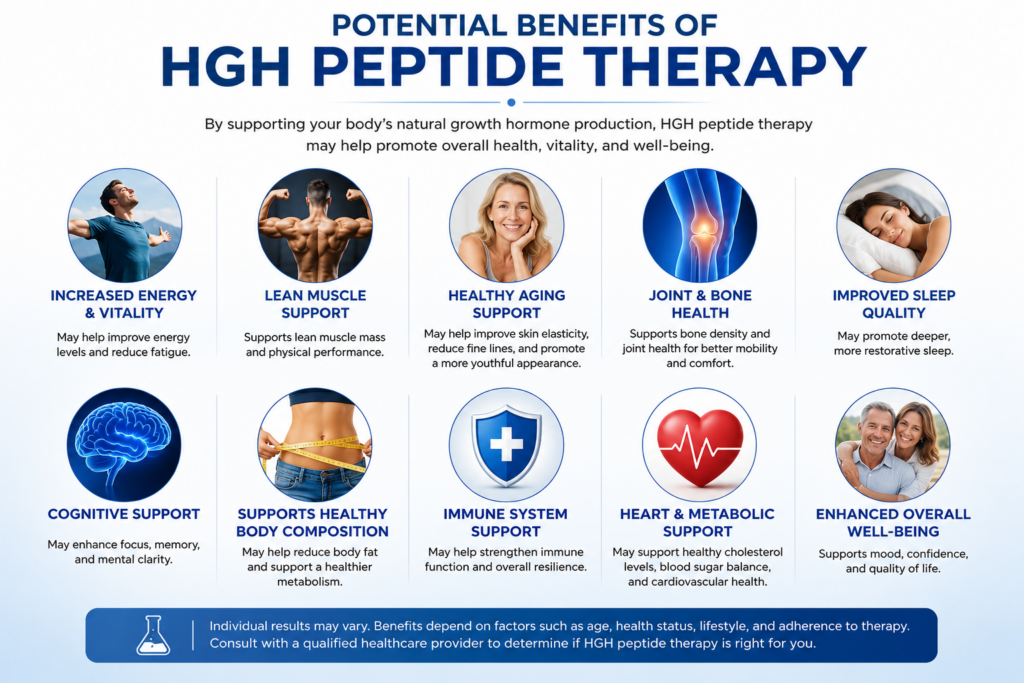
Growth hormone and its downstream messenger, insulin-like growth factor 1—or IGF-1—are involved in several important physiological processes, including:
Collagen synthesis and tissue remodeling
Protein synthesis
Exercise recovery
Lean-tissue maintenance
Fat metabolism and body composition
Bone remodeling
Sleep-related repair processes
The degree of response varies among individuals and can be affected by age, pituitary function, metabolic health, sleep, nutrition, other hormones, and overall health.
How Are Sermorelin and Collagen Production Connected?
Sermorelin and Collagen Production
Collagen is commonly promoted for its cosmetic role, but its importance extends throughout the body.
Tendons and Ligaments
Tendons connect muscles to bones, while ligaments help stabilize joints. Both contain substantial amounts of collagen and depend on a healthy extracellular matrix for strength and resilience.
Cartilage and Joints
Collagen is an important structural component of cartilage. Healthy cartilage helps joints move smoothly and withstand the physical stress associated with everyday movement and exercise.
Bones
Bones are not composed only of minerals. Collagen forms an important structural framework that contributes to bone flexibility and integrity. The growth hormone–IGF-1 pathway also participates in normal bone turnover and remodeling.
Muscles and Connective Tissue
Muscle function depends on more than muscle fibers alone. Muscles are surrounded and supported by collagen-rich connective tissues that help transmit force and maintain structural organization.
Skin, Hair and Nails
Collagen contributes to the structure and elasticity of skin and to the tissues supporting normal hair and nail growth. Effects of Sermorelin on hair and nails are less well established, however, and individual results vary.
Sermorelin, Collagen Production and Recovery
Research involving growth hormone has demonstrated increased collagen synthesis in human skeletal muscle and tendon. This provides a biological basis for the relationship between the growth hormone–IGF-1 pathway, connective-tissue maintenance, and recovery.
However, research involving growth hormone should not automatically be interpreted as proof that Sermorelin will produce the same degree of benefit in every patient. Sermorelin stimulates natural growth hormone signaling, and individual response depends on many clinical factors.
By supporting this natural pathway, Sermorelin may contribute to:
- Connective-tissue maintenance
- Recovery from exercise and physical stress
- Improved tissue resilience
- Mobility and physical function
- Lean-body-mass support
- Healthier body composition
For active adults and people rehabilitating an injury, this support may complement a broader recovery plan. Sermorelin does not replace medical treatment, physical therapy, progressive rehabilitation, proper nutrition, adequate protein intake, or appropriate exercise.
Can Sermorelin Help With Injury Rehabilitation?
Collagen production and tissue remodeling are important parts of the body’s normal healing process. Because the growth hormone–IGF-1 pathway participates in these processes, Sermorelin may provide additional support for recovery and rehabilitation when clinically appropriate.
It should not be represented as a treatment that guarantees accelerated healing or prevents future injuries. The type and severity of the injury, age, nutrition, circulation, physical therapy, underlying health conditions, and adherence to rehabilitation all affect recovery.
Patients with an injury should first receive an appropriate diagnosis and evidence-based treatment plan from a qualified medical professional.
Sermorelin and Testosterone Therapy
Sermorelin and testosterone replacement therapy affect different but potentially complementary physiological pathways.
When clinically indicated, optimized testosterone may support:
- Muscle mass and strength
- Energy and motivation
- Sexual health
- Bone health
- Body composition
- Overall vitality
Sermorelin supports the growth hormone–IGF-1 pathway, which is involved in:
- Collagen production
- Connective-tissue maintenance
- Recovery and repair
- Sleep-related recovery
- Lean-tissue maintenance
- Fat metabolism and body composition
For appropriately selected patients, addressing both pathways may provide more comprehensive support than focusing on testosterone alone. Each treatment must be independently appropriate and based on symptoms, medical history, laboratory findings, health goals, and physician evaluation.
Why Medical Evaluation and Monitoring Matter
Sermorelin is not appropriate for everyone, and peptide therapy should never be treated as a one-size-fits-all wellness product.
At RenewFX, peptide therapy begins with a comprehensive evaluation that considers the patient’s:
- Symptoms and health concerns
- Medical and medication history
- Lifestyle and activity level
- Sleep and recovery
- Body-composition goals
- Hormonal and metabolic health
- Relevant laboratory findings
When Sermorelin is clinically appropriate, treatment is personalized and monitored under the oversight of an experienced, board-certified physician. Follow-up evaluations and laboratory testing help assess response, tolerability, and whether adjustments are necessary.
Frequently Asked Questions
Is Sermorelin the same as HGH?
No. Recombinant HGH supplies growth hormone directly. Sermorelin signals the pituitary gland to increase the body’s own production and release of growth hormone.
Does Sermorelin increase collagen production?
Sermorelin supports the natural growth hormone–IGF-1 pathway, which is involved in collagen synthesis and tissue remodeling. Individual clinical results vary, and benefits cannot be guaranteed.
Can Sermorelin be used with testosterone therapy?
Sermorelin and testosterone therapy may be considered together when each treatment is independently appropriate. The two therapies affect different but overlapping aspects of muscle, bone, connective-tissue, metabolic, and hormonal health.
Is Sermorelin appropriate for everyone?
No. Treatment should be based on a comprehensive medical evaluation, relevant laboratory findings, potential benefits and risks, and the prescribing physician’s clinical judgment.
Supporting Strength, Recovery and Long-Term Function
Healthy aging is not about trying to become 25 again. It is about preserving—and, when possible, improving—the strength, mobility, recovery, and physical capacity that allow you to continue doing the things you enjoy.
Collagen is central to that process. Supporting the hormonal pathways involved in collagen production and tissue maintenance may be one part of a comprehensive, physician-guided approach to healthy aging.
To learn about Sermorelin and collagen production, and whether Sermorelin or another personalized treatment may be appropriate for you, contact the RenewFX care team or call (713) 936-4103.
Individual results vary. Peptide therapy requires medical evaluation and should be prescribed and monitored by a qualified healthcare professional. This information is educational and is not a substitute for individualized medical advice.